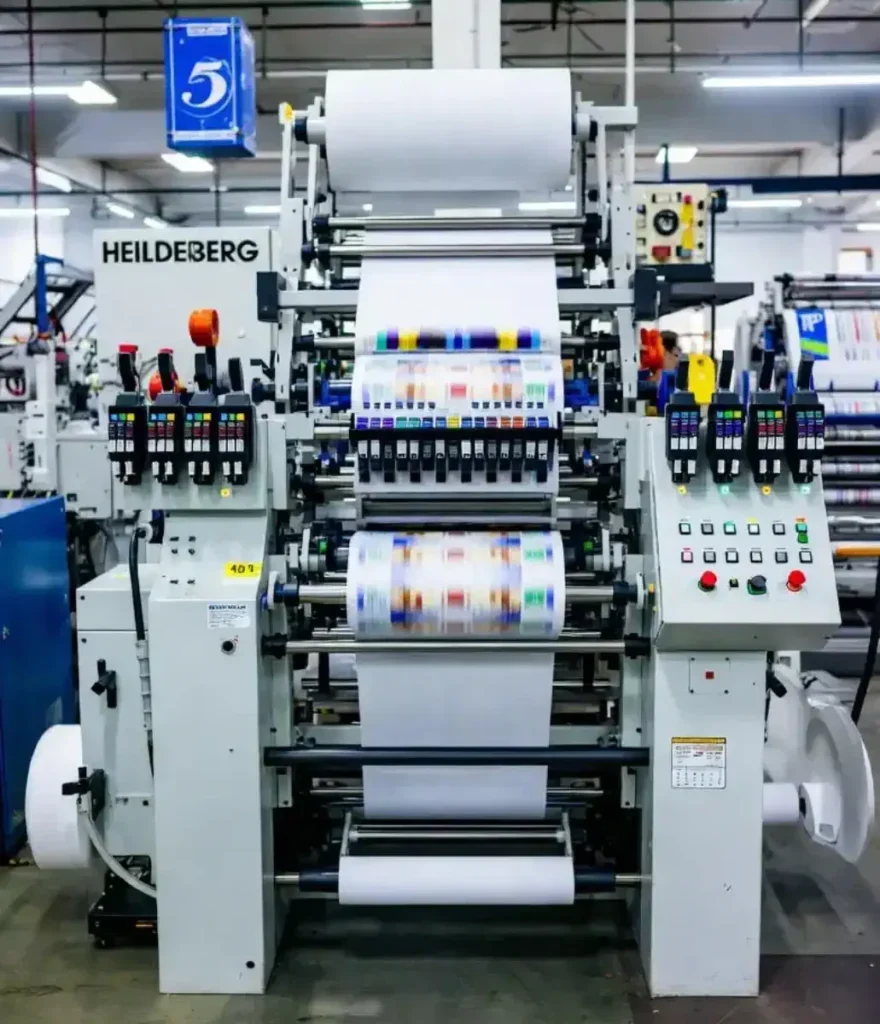
Flexo Printing

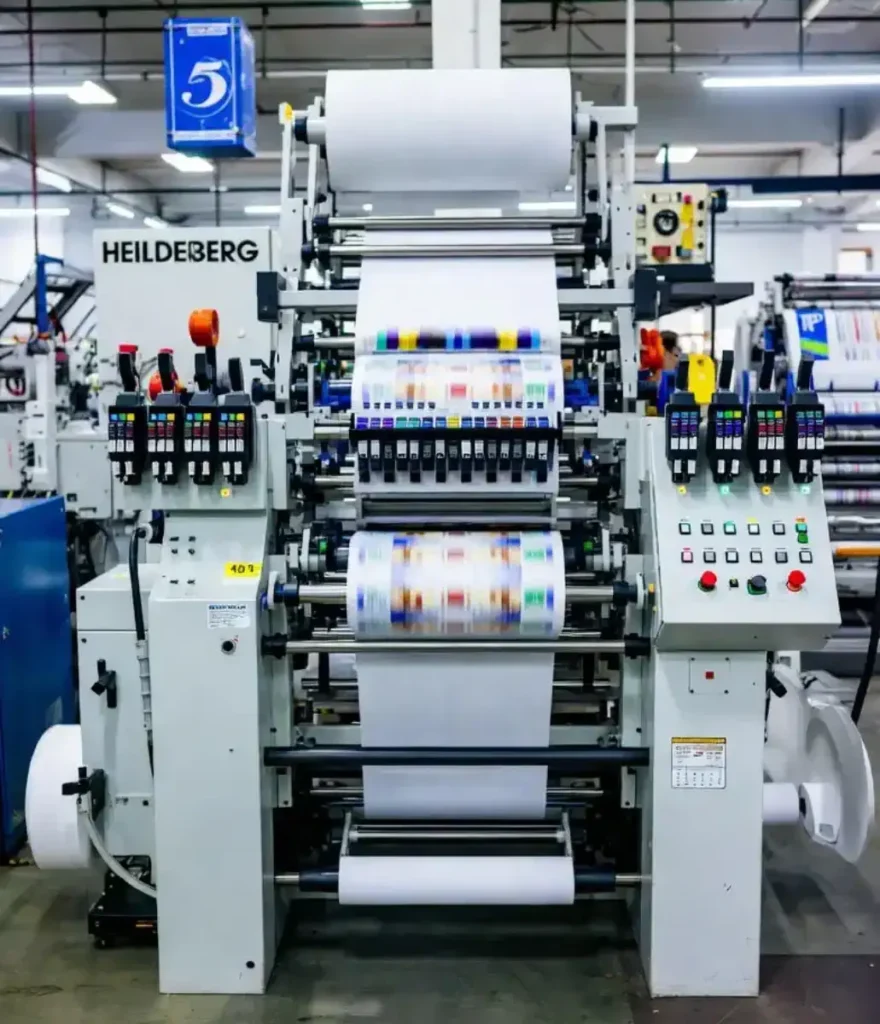
Flexo Printing
Flexo (Flexographic) printing is a high-speed rotary printing process that uses flexible photopolymer plates and an anilox roller to transfer ink onto the substrate.
It is the most widely used technique in packaging, especially for:
- Corrugated boxes
- Labels & stickers
- Flexible packaging (OPP, BOPP, PET, PE films)
- Paper bags & kraft packaging
- Tissue & napkin printing
- Cartonboard (FBB, SBS, Kraftliner)
- What Is Flexo Printing?
Flexography is a relief printing method:
- The printing areas are raised (relief) on a flexible polymer plate.
- Ink is delivered to the plate by an anilox roller, then transferred to the substrate.
It is designed for continuous, high-speed production and works with fast-drying, low-viscosity inks.
- Flexo Printing Techniques (Major Types)
- CI Flexo (Central Impression Drum)
- Most common for flexible packaging
- The substrate moves around a large central drum
- Perfect registration and stability for thin films (12–50 microns)
Used for:
- Snack packaging
- Shrink sleeves
- Laminated films
- Bread bags
- Frozen food pouches
- Inline Flexo (Stack Type / Inline System)
- Positioned in a straight line
- Ideal for labels, cartons, corrugated preprint
Used for:
- Pressure-sensitive labels
- Folding cartons
- Paper bags
- Envelopes
- Stack-Type Flexo
- Printing units are stacked vertically
- Works with thicker materials
Used for:
- Kraft paper
- Nonwoven
- Tissues
- Some flexible packaging
Corrugated Flexo (Postprint Flexo)
Two methods:
- Direct Postprint (DPP)
- Printing directly on corrugated board
- Fast & economical
- Used for shipping boxes, e-commerce boxes
- Preprint Flexo
- Printing on liner roll, then laminating to corrugated
- High-quality printing (near-offset quality)
Used for:
- Premium corrugated boxes
- Colorful packaging
- Flexo Printing Process — Step-by-Step
- Prepress & Plate Production
Flexo uses photopolymer plates (1.14 mm, 1.7 mm, 2.84 mm, 4.7 mm, 5.5 mm, 6.35 mm).
Plate workflow:
- Digital design in CMYK/Pantone
- Trapping, distortion, screening adjustments
- RIP processing
- Laser imaging (LAMS mask)
- Plate exposure
- Plate washout
- Drying
- Light finishing & post-exposure
- Plate mounting to cylinder (tape thickness affects dot gain)
- Inking System (Anilox Technology)
Anilox Roller = The heart of flexo
It meters ink with microscopic engraved cells.
Key Specs:
- LPI (lines per inch): 60–1500 LPI
- BCM (cell volume): determines ink amount
- Cell angle: 30°, 45°, 60° (most common)
- Cell shape: hexagonal, elongated, tri-helical
A low LPI = more ink (corrugated).
A high LPI = fine detail (labels, films).
- Ink Transfer
Flow:
Ink Chamber → Anilox → Plate → Substrate
Ink types:
- Water-based (most common for paper, corrugated)
- Solvent-based (best for films)
- UV-curable (premium labels, high-gloss)
- EB (Electron Beam) inks (high-end food packaging)
Flexo inks are:
- Low-viscosity
- Fast drying
- Low migration (food safe)
- Drying/Curing
Different depending on ink type:
- Hot Air (convection) – standard
- IR Drying
- UV Dryers (for UV inks)
- EB curing (rare but highest quality)
Films require low-heat and controlled tension.
- Finishing & Converting
Flexo lines can include:
- Varnish unit (mat/gloss)
- Cold foil
- Hot foil
- Die-cutting
- Lamination
- Slitting
- Rewinding
Labels often include:
- Die punching
- Matrix stripping
- Rewind into rolls
- Materials Used in Flexo Printing
Flexible Packaging Films
- BOPP
- OPP
- PET
- PE
- CPP
- Nylon / PA
- PVC
- Shrink films
Paper & Carton
- Kraft paper
- Linerboard
- Cartonboard
- Newsprint
- Tissue & napkin paper
Corrugated Board
- E-, B-, C-, BC flute
- White-top testliner
- Kraftliner
Other Materials
- Aluminium foil
- Nonwoven fabric
- Cold-seal coating substrates
- Flexo Printing Quality Parameters
- Dot Gain (Tonal Reproduction)
Flexo has higher dot gain than offset.
Controlled by:
- Anilox BCM
- Plate hardness
- Tape thickness
- Impression pressure
- Registration Accuracy
Best in:
- CI flexo (excellent)
- Inline flexo (very good)
- Corrugated flexo (medium)
- Defects to Control
- Pinholing
- Dirty print
- Haloing
- Feathering
- Bar marking
- Gear marks
- Bouncing
- Plate lift
- Advantages of Flexo Printing
| Feature | Benefit |
|---|---|
| High-speed production | 200–600 m/min for films |
| Lowest unit cost for packaging | Economical for mass production |
| Works with many substrates | Paper, film, foil, corrugated |
| Inline finishing | Varnish, foil, die-cutting directly |
| Food-safe inks available | Key for FMCG industries |
| Faster drying | Higher productivity |
- Limitations of Flexo Printing
- Lower resolution compared to offset & gravure
- Higher plate cost
- Dot gain challenges
- Sensitive to impression pressure
- Ink viscosity must be constantly monitored
- Not cost-effective for very small quantities
- Flexo Printing Machine Brands
- BOBST (master for flexible packaging)
- Windmöller & Hölscher (W&H)
- Uteco
- Comexi
- Fischer & Krecke (F&K / W&H)
- Nilpeter (labels)
- Gallus (labels)
- Mark Andy (labels)